

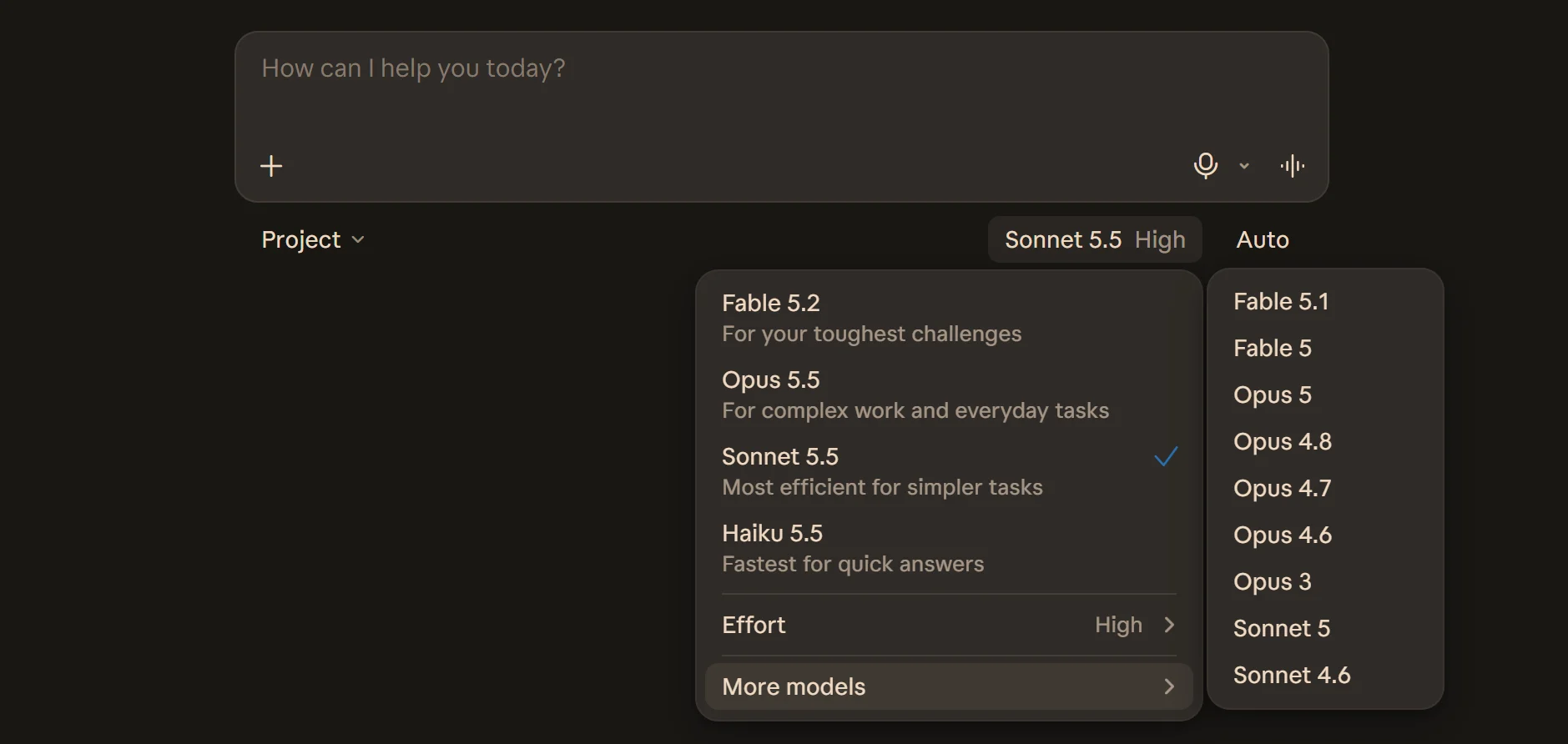
Where Fable Fits in the Claude Lineup (Fable vs. Mythos vs. Opus 5.5)
Before comparing the three Fable versions, it helps to understand two quirks in how Anthropic packages its top models:
- Claude Fable and Claude Mythos are the exact same model underneath: Both share identical model weights, architecture, and pricing. The only difference is the safety filter configuration. Claude Fable is open to all paying users with strict cybersecurity and biology classifiers, while Claude Mythos unlocks those guardrails for vetted defensive-security and life-sciences teams (under programs like Project Glasswing).
- Fable is not meant to be your everyday chatbot: Even in the Fable 5.2 release notes, Anthropic tells most developers to stick with Claude Opus 5.5 ($4 input / $20 output per million tokens) for day-to-day coding and writing. Fable is built for the hardest 5% of tasks: multi-hour autonomous debugging, hardware CAD design, formal mathematical proofs, and orchestrating smaller subagents.
Claude Fable 5 vs. Fable 5.1 vs. Fable 5.2: Full Spec & Pricing Table
Here is how the rate card and core specs evolved from June to November 2026 across all three generations:
| Specification / Price | Claude Fable 5 | Claude Fable 5.1 | Claude Fable 5.2 |
|---|---|---|---|
| Release Date | June 9, 2026 | September 1, 2026 | November 9, 2026 |
| API Model ID | claude-fable-5 | claude-fable-5-1 | claude-fable-5-2 |
| Context Window / Max Output | 1M / 128K tokens | 1M / 128K tokens | 1M / 128K tokens |
| Reliable Knowledge Cutoff | January 2026 | June 2026 | June 2026 |
| Standard API Input / Output | $10 / $50 per MTok | $10 / $50 per MTok | $8 / $40 per MTok (-20%) |
| Prompt Cache Read | $1.00 per MTok | $0.25 per MTok (-75%) | $0.20 per MTok (-20%) |
| Cache Write (5-min / 1-hr) | $12.50 / $20.00 per MTok | $12.50 / $20.00 per MTok | $10.00 / $16.00 per MTok |
| Batch API (Input / Output) | $5 / $25 per MTok | $5 / $25 per MTok | $4 / $20 per MTok |
| Fast Mode API (Up to 2.5x Faster) | Not available | Not available | $16 / $80 per MTok |
The Evolution: How Each Fable Release Fixed the Previous One
1. Claude Fable 5 (June 2026): Huge Brain, Bumpy Launch
When Anthropic launched Claude Fable 5 on June 9, 2026, it introduced a new tier above Opus with a 1-million-token context window, 128,000 max output tokens, and mandatory adaptive thinking that cannot be switched off. Instead of toggling thinking on or off, developers steer reasoning depth using the effort parameter.
The launch hit an immediate snag: on June 12, 2026, Fable 5 was suspended under US export controls after researchers found a safeguard bypass, before returning globally on July 1, 2026. Once developers got their hands on it, three practical issues stood out:
- Painful cache-read bills: At $1.00 per million cached input tokens, an agent in Claude Code rereading a huge codebase 50 times in a loop burned through budgets fast.
- Drift during long tasks: Engineering teams noted that the longer Fable 5 worked on multi-step problems, the harder its reasoning became to follow.
- Aggressive safety refusals: Overly sensitive cybersecurity filters frequently blocked legitimate defensive code reviews and vulnerability checks.
2. Claude Fable 5.1 (September 2026): Cheaper Caching and Multi-Day Stamina
Released on September 1, 2026, Claude Fable 5.1 kept the $10 input and $50 output base price, refreshed the knowledge cutoff to June 2026, and focused on fixing every major complaint from the June release.
- A 75% price cut on cache reads: Anthropic slashed prompt cache reads from $1.00 down to $0.25 per million tokens. That dropped average bills by roughly 25% and cut context-heavy agent costs by up to 45%.
- The output token catch: There was one catch to Fable 5.1’s pricing. At maximum effort, Fable 5.1 double-checked its own work so aggressively that it generated roughly 1.7x more output tokens than Fable 5. In third-party tests where cache hits were low, a completed task could actually cost more on 5.1 ($3.76) than on 5.0 ($3.14).
- Massive jump in scientific and terminal work: On Terminal-Bench-Science 0.1, Fable 5.1 more than doubled Fable 5’s score, jumping from 24.7% to 52.6%. On Terminal-Bench 4.0, it climbed from 42.0% to 55.8% (with unrestricted Mythos 5.1 hitting 60.9%).
- 60% fewer false refusals & better privacy: Anthropic tuned its cyber filters so Fable 5.1 could find software bugs without refusing, added a crop-and-zoom vision pattern for reading dense charts in PDFs, added invisible EU AI Act watermarking, and rolled out zero data retention alongside Enterprise Frontier Safeguards (EFS).
3. Claude Fable 5.2 (November 2026): 20% Cheaper, 30% Faster, and Less Wordy
On November 9, 2026, Anthropic released Claude Fable 5.2 (moving 5.1 to legacy status ahead of its September 2027 retirement). If Fable 5.1 was about making agents reliable, Fable 5.2 is about making them fast and economical.
- Across-the-board 20% price drop: Base pricing fell to $8 input and $40 output per million tokens, while cache reads dropped to $0.20 per million tokens (matching Opus 5.5’s cache read rate). Using the Batch API cuts Fable 5.2 to $4 input / $20 output.
- Real-world agent bill comparison: If you run a long coding session that processes 2 million input tokens (with a 90% cache hit rate) and writes 200,000 output tokens, the session costs roughly $12.45 on Fable 5.1, drops to $9.96 on Fable 5.2, and costs $5.16 on Opus 5.5.
- 30% faster generation + Fast Mode: Standard output speed is up to 30% faster than 5.1. If latency is critical, a new API Fast mode generates tokens up to 2.5x faster for $16 input / $80 output per MTok.
- Smarter token efficiency across effort levels: You can set
efforttolow,medium,high,xhigh, ormax. Because Fable 5.2 wastes far fewer tokens spinning its wheels, running Fable 5.2 at High effort on FrontierCode matches Opus 5.5’s best score (45.3% vs. 45.5%) for half the cost per task. On Chartography (66.4%) and Humanity’s Last Exam at Low/Medium effort, Fable 5.2 beats Max-effort Opus 5.5 for less than one-tenth the cost per task. - Wild engineering milestones: In pre-release testing, Fable 5.2 wrote a working hypervisor in a single session backed by over 3,500 machine-checked proofs, formalized the proof of Fermat’s Last Theorem in 30 hours, solved two open problems in black hole physics, designed three working electronic circuits from scratch, and rewrote a production Python service into Rust that boots 26x faster.
Benchmark Progression: Fable 5 vs. 5.1 vs. 5.2
| Benchmark (What It Measures) | Fable 5 | Fable 5.1 | Fable 5.2 |
|---|---|---|---|
| AutomationBench (End-to-end business workflows) | 17.1% | 31.4% | 51.4% |
| Remote Labor Index (Autonomous knowledge work) | — | 17.9% | 41.3% |
| OSWorld 2.1 (GUI & desktop computer use) | — | 83.5% | 89.3% |
| Humanity’s Last Exam (Expert reasoning with tools) | 63.8% | 65.6% | 74.2% |
| BenchCAD 2.1 (Hardware & circuit design, 0–100) | — | 44.4 | 83.5 |
| FrontierCode (Open-source PR merge rate, Xhigh effort) | — | — | 49.1% |
Watch Out: API Breaking Changes When Migrating to Fable 5.1 / 5.2
If you are updating an existing agent harness from Opus or Fable 5 to Fable 5.2, swapping the model string to claude-fable-5-2 is not enough. Three API rules will break older code if you do not account for them:
- Forced tool use returns a 400 error: Because adaptive thinking is always on, passing a
tool_choiceconfiguration that forces a specific tool call without allowing a thinking turn triggers an immediate HTTP 400 error. - Mutating conversation history invalidates thinking blocks: If your agent framework edits earlier user turns, trims messages, or tweaks the system prompt mid-conversation, Fable 5.2 invalidates prior cached thinking blocks across all accounts. Run Anthropic’s prefix-check test before deploying.
- No backward compatibility on thinking blocks: Only Fable 5.2 (and Mythos 5.2) can read thinking blocks generated by Fable 5.2. If you route a conversation from Fable 5.2 down to Opus 5.5 mid-thread, you must strip or handle those thinking blocks properly.
Full Claude Limit Reset vs. Fable Limit Reset: How They Actually Work
If you use Claude through a paid subscription (Pro, Max, Ultra, or Team) rather than the raw API, Fable models eat through your usage allowance much faster than Sonnet or Opus. To help users test Fable 5.2 without hitting a brick wall, Anthropic rolled out promotional Fable limit resets—and thousands of users have already wasted theirs because they misunderstood how the math works.
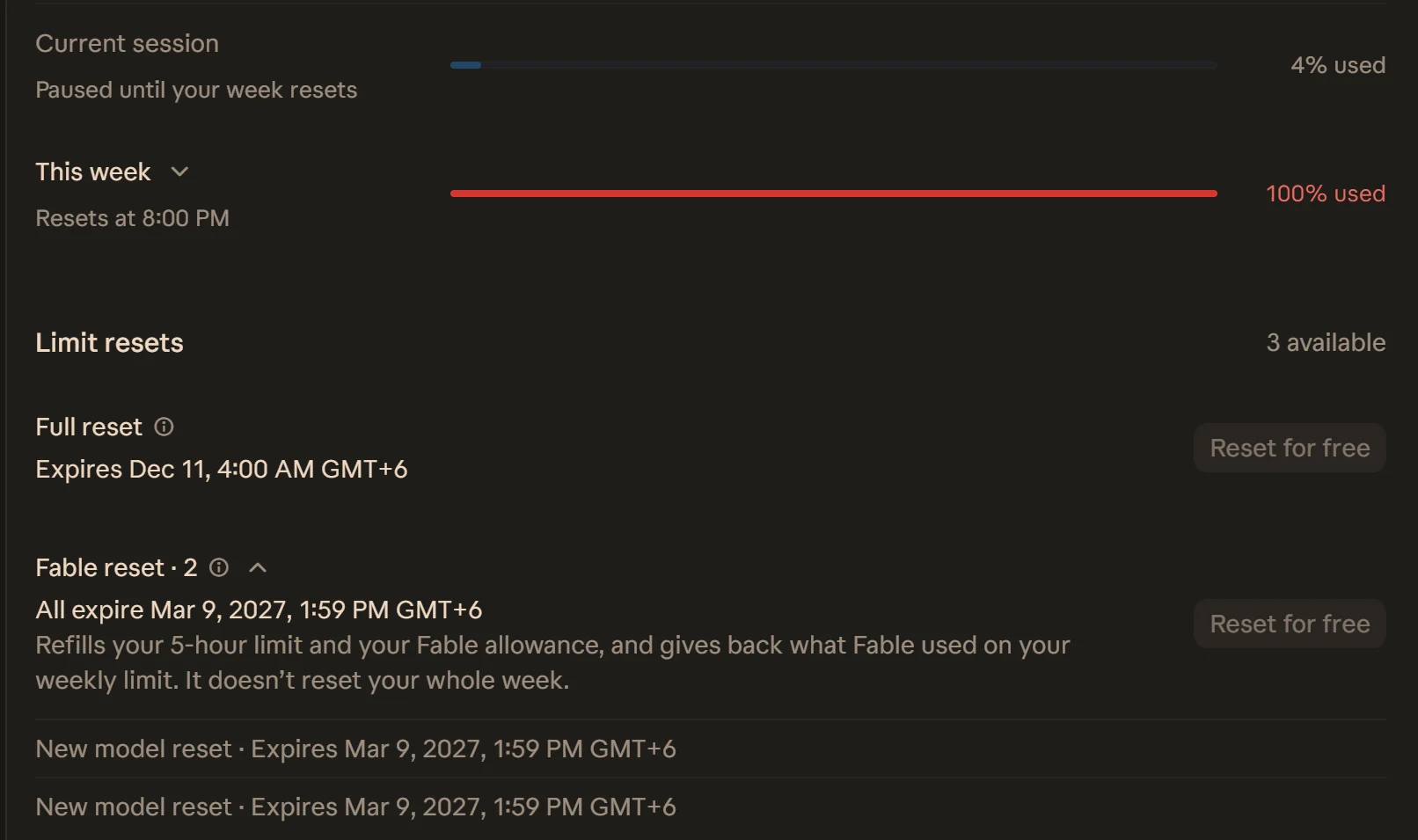
The 3 Types of Limit Resets on Claude
Inside Settings → Usage, Anthropic grants three distinct types of manual limit resets. They are not interchangeable:
- 1. Full Weekly Limit Reset: Wipes your entire weekly usage counter back to 0% used (100% available) across every model on your plan—Opus, Sonnet, Haiku, and Fable alike. Because a week has 168 hours and your regular weekly reset day does not change, triggering a full weekly reset mid-week gives you a genuine bonus bucket of tokens.
- 2. Five-Hour Session Reset: Instantly refills your rolling 5-hour session cap to 100%, but does not touch your weekly ceiling. Because a 168-hour week contains 33.6 five-hour windows, a standalone session reset only buys back about 3% of the week’s clock time—and every message you send after clicking it still drains your same weekly limit.
- 3. Fable Limit Reset (The New Hybrid Reset): This reset does two different things at once:
- On your Weekly Limit: It refunds only the weekly percentage you spent on Fable models (Fable 5, 5.1, and 5.2). Any weekly quota you spent on Opus, Sonnet, or Haiku stays untouched.
- On your 5-Hour Session Limit: If your account has a 5-hour session cap, it refills the entire 5-hour window back to 100%, even if you burned that 5-hour window using Opus or Sonnet. (Note: Verified Ultra accounts do not have a 5-hour cap, so a Fable reset only affects their weekly Fable usage.)
The Quota Math: Why Users Are Accidentally Wasting Their Fable Reset
Here is a concrete example of how a Fable limit reset calculates your refund:
Scenario A (Smart Reset): You are at 80% of your weekly limit—you spent 50% on Fable 5.2 and 30% on Opus 5.5. You click “Reset for free.” The system subtracts the 50% Fable usage from your weekly bar, dropping you from 80% back down to 30% weekly usage, and refills your 5-hour session bar to full.
Scenario B (Wasted Reset): You spent 96% of your weekly limit on Opus 5.5 and only 4% on Fable 5.2. You hit your weekly wall and click your Fable reset hoping to get more Opus time. The system only refunds the 4% Fable slice—leaving you stuck at 96% weekly usage with one less reset in your account.
Who Gets the Fable 5.2 Launch Offer and When Resets Expire
To qualify for the Fable 5.2 launch offer, your account must have had active paid billing (or an active self-serve Team trial) before November 9, 2026 at 10:00 AM PT. If you started a free trial before that cutoff, your reset unlocks as soon as your trial converts to paid.
| Claude Plan Tier | What You Receive | Expiration Date |
|---|---|---|
| Claude Pro & Team Standard Seats | Fable models included for 1 week (up to 50% of your weekly usage limit) + 1 Fable limit reset | November 16, 2026 at 11:59 PM PT |
| Max, Ultra, Team Premium & Legacy Enterprise Premium (Subscribed < 6 months) | 1 Fable limit reset | March 8, 2027 at 11:59 PM PT |
| Max, Ultra, Team Premium & Legacy Enterprise Premium (Subscribed 6–12 months) | 2 Fable limit resets | March 8, 2027 at 11:59 PM PT |
| Max, Ultra, Team Premium & Legacy Enterprise Premium (Subscribed > 12 months) | 3 Fable limit resets | March 8, 2027 at 11:59 PM PT |
Note on subscription tenure: Anthropic counts your total cumulative time as a paying customer from your very first paid bill—even if you paused your subscription or switched plans in between. Free plans, self-serve Enterprise, usage-based Enterprise, and standard seats on legacy Enterprise plans are excluded.
How to Trigger Your Reset (Including for Claude Code)
- Open Claude on the web, Claude Desktop, or the Claude mobile app. (There is no reset button inside the Claude Code terminal or IDE extension yet, but your quota is shared account-wide—resetting on the web immediately unlocks Claude Code.)
- Go to Settings → Usage.
- Scroll to the Limit resets section, click Reset for free, and confirm.
4 Rules to Get Maximum Value from Your Resets and Fable 5.2
- Use the “Fable First” weekly strategy: At the start of your billing week, do your heavy architectural work exclusively on Fable 5.2 (up to the 50% weekly cap on Pro, or higher on Max/Ultra) before touching Opus or Sonnet. Then hit your Fable limit reset. Your weekly usage drops all the way back to 0%, effectively giving you that entire block of Fable 5.2 compute for free before you switch back to Opus 5.5 for the rest of the week.
- Never click reset while a prompt is still running: Users on Reddit quickly discovered that triggering a Fable limit reset mid-generation can kill an active multi-step prompt and wipe its in-progress state. Always wait for your current response or Claude Code step to finish before clicking the button.
- Do not reset right before your scheduled weekly rollover: Using a limit reset Does NOT change the day and time your regular weekly limit refreshes. If your weekly bar naturally resets on Thursday at 2:00 PM, burning a manual reset on Thursday at 11:00 AM wastes almost the entire grant.
- Route subagents in
CLAUDE.mdto save quota: Even with Fable 5.2’s 20% price cut, burning Fable quota on simple boilerplate code is overkill. In Claude Code, configure yourCLAUDE.mdfile to use Fable 5.2 for initial system design, complex bug root-causing, and final pre-merge code review, while delegating routine file edits and test writing to Opus 5.5 subagents.
Last Updated on November 10, 2026 by Logan Carter


Comments