


Agent washing happens when ordinary software, basic automation, or a chatbot gets marketed as a full AI agent. That can make a product sound more autonomous than it really is. To avoid the hype, evaluate what the system actually does, how much human guidance it needs, and whether it can take reliable actions beyond generating text.
Quick Answer
Agent washing occurs when companies label standard software, workflows, or simple chatbots as AI agents to make them sound more advanced. A real AI agent should perceive context, reason through tasks, take observable actions, adapt from feedback, and work with some level of autonomy rather than waiting for every instruction.
Key Takeaways
- Agent washing is a marketing problem, not always a technical one.
- A real AI agent should do more than answer prompts or summarize text.
- The five useful tests are autonomy, action-taking, perception, adaptivity, and proactivity.
- A product can have agent-like features without being a complete agent.
- Reliability matters as much as capability, especially for business-critical workflows.
How to Spot AI Agent Washing and Avoid Marketing Hype
Companies often slap an AI label on old features to call them agents. This practice is known as agent washing. It creates confusion, wastes your time, and hurts your budget when a product fails to deliver on promises of autonomy or reliability.
You need a way to tell whether a product is a genuine AI agent or just marketing spin. This guide provides a five-part checklist you can use as a buyer or builder to verify claims before you commit.
What an AI Agent Really Is
An agent perceives its environment through sensors and acts upon that environment through actuators. In plain English, that means an agent receives information from the world around it, processes that information, and then takes an action that changes something.

Put simply, an AI agent must do three basic things:
- Perceive context by understanding inputs like prompts, files, apps, calendars, records, or web data
- Reason about that context to decide on the best next step
- Act by taking observable steps in a system instead of only returning text
Note: Not every AI-powered tool needs to be an agent. A writing assistant, search assistant, or chatbot can still be useful even if it does not qualify as a full autonomous agent.
The Five-Part Agent Checklist
Major AI platforms often describe agents using similar ideas, even if they use different wording. Use these five criteria when you evaluate any product marketed as an agent.
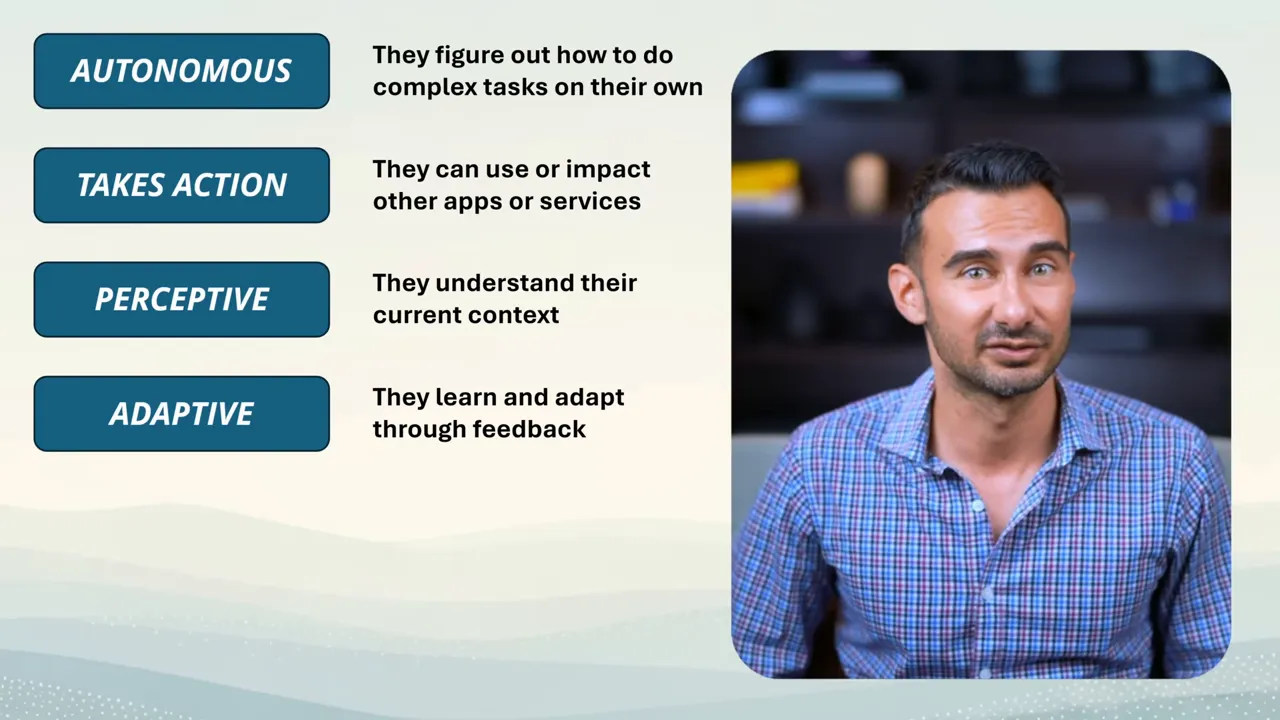
- Autonomous: It achieves goals without needing step-by-step instructions for every move.
- Action-taking: It performs observable tasks, such as sending emails, updating records, creating tickets, categorizing transactions, or changing settings.
- Perceptive: It interprets data from its environment, such as calendars, expense reports, CRM records, documents, messages, or websites.
- Adaptive: It learns from feedback, corrections, outcomes, or preferences and adjusts its behavior over time.
- Proactive: It initiates work when it detects tasks that need doing rather than waiting for every prompt.
AI Agent Scorecard
| Autonomy | Can the system pursue a goal without needing every step written out? |
| Action | Can it do something visible in another tool, database, inbox, workflow, or system? |
| Perception | Can it read and understand useful context from its environment? |
| Adaptivity | Does feedback change future behavior, or does the tool repeat the same mistakes? |
| Proactivity | Can it start useful work based on a trigger, schedule, condition, or detected need? |
Testing Real Examples With the Scorecard
Below we run several known products through the five-part scorecard. The point is not to label every tool as good or bad. The goal is to show how to separate real capability from inflated positioning.
ChatGPT Deep Research
Deep Research produces detailed analysis on a topic. It can plan research steps, gather information, compare sources, and synthesize findings into a structured report.

- Autonomous: Yes, it plans searches and synthesis after a short prompt.
- Action-taking: No, it mainly returns text rather than executing external actions in business systems.
- Perceptive: Yes, it gathers, reads, and ingests information.
- Adaptive: Somewhat, it adapts within one session but does not consistently learn across every future session by default.
- Proactive: No, it waits for user prompts.
Deep Research has agent-like abilities but does not meet every requirement. This is fine if you need a research assistant instead of an autonomous actor that changes records, sends messages, or completes workflows.
Presto Automation
Presto Automation claimed its voice system could remove human order takers from drive-throughs. Later, regulators alleged that some claims were misleading because many locations still required human intervention.

This is a clear example of agent washing. The product failed the autonomy test in practice when it required more oversight than advertised and did not reliably replace human effort at the level buyers may have expected.
Warning: Do not judge an AI agent only by a polished demo. Ask how often humans intervene, what failure cases look like, and whether the vendor can show performance in real production use.
QuickBooks Online Accounting Agent
QuickBooks released an accounting agent designed to auto-categorize expenses and surface tax-deductible items before you log in.

- Autonomous: Yes, it categorizes data without step-by-step direction.
- Action-taking: Yes, it applies categories automatically.
- Perceptive: Yes, it reads and interprets expense data.
- Adaptive: Yes, it can learn from manual corrections and apply them later.
- Proactive: Yes, it can finish work ahead of your login.
This agent meets the five characteristics and delivers tangible gains for bookkeeping tasks when it performs reliably. The key buyer question is not only whether it can categorize expenses, but how accurately it does so across messy real-world records.
Microsoft Copilot Studio
Copilot Studio lets you create agents that help with tasks like prepping for meetings by reading your calendar, reviewing data, triggering workflows, and connecting to business systems.
- Autonomous: Yes, agents can perform multi-step tasks.
- Perceptive: Yes, they can read calendar entries and other inputs.
- Action-taking: Yes, they can send emails or trigger connected workflows when configured.
- Adaptive: Possible, but it often requires thoughtful design, feedback loops, or extra engineering.
- Proactive: Yes, triggers and scheduled behaviors are supported.
Copilot Studio is powerful, but building robust adaptivity often requires extra planning. A weak build can still feel like a simple chatbot even when the platform itself supports more advanced agent behavior.
Custom GPTs
Custom GPTs are tuned instances of ChatGPT for specific tasks like drafting posts from transcripts, answering support questions, formatting documents, or following a custom workflow.
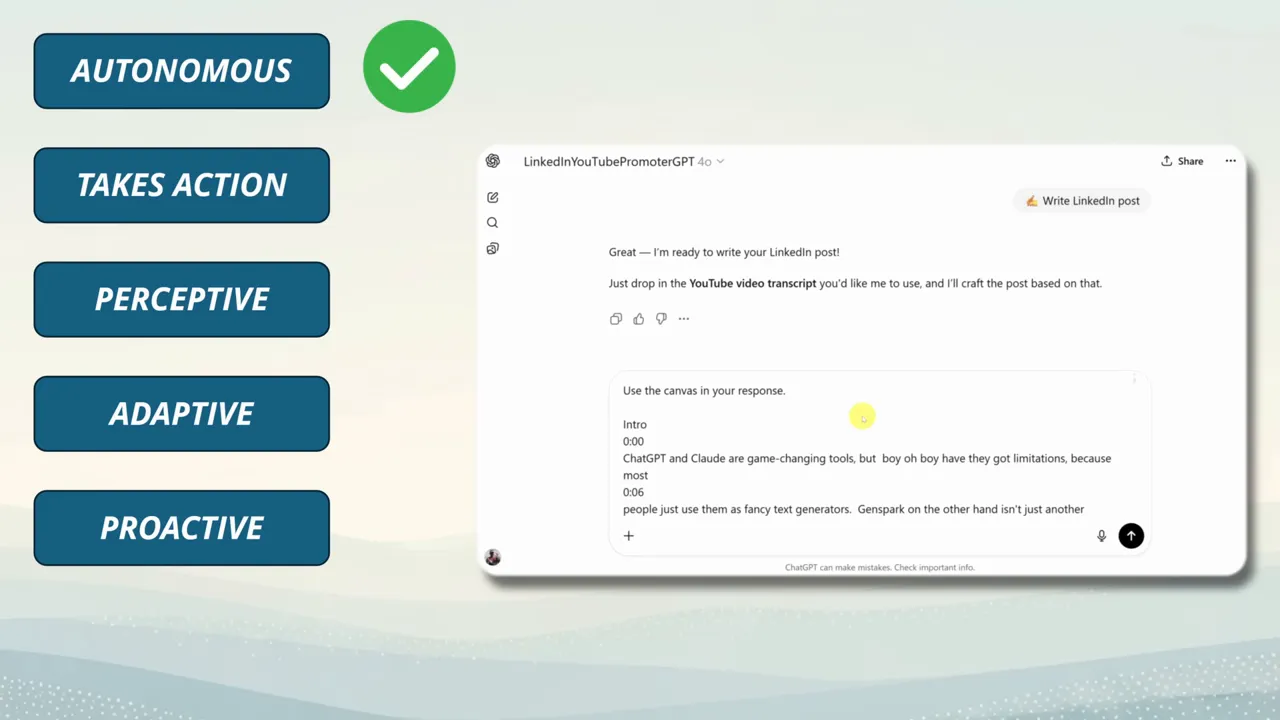
- Autonomous: Yes, they can perform complex text tasks after receiving instructions.
- Perceptive: Yes, they read the inputs you provide.
- Action-taking: Possible, but technical, because you need extra setup to connect to external systems.
- Adaptive: Limited, because session-level adjustments do not always persist automatically.
- Proactive: No, most require a user prompt to start.
Custom GPTs bridge the gap between chatbots and agents. However, they do not automatically qualify as full agents in every case. Without external actions, durable memory, triggers, and guardrails, they are often better described as specialized assistants.
How to Tell Agent Washing From a Real Agent
When a vendor says a product is agentic, ask for evidence. The best proof is not a landing page claim. It is a repeatable workflow where the system senses context, decides what to do, acts in a connected environment, and improves from feedback.
Pro Tip: Ask the vendor to show a boring real workflow, not a perfect demo. Real agent quality shows up when data is incomplete, tasks change, users correct mistakes, or the system reaches a safe stopping point.
Use these buyer questions before you trust the label:
- What does it do without a user prompt? If nothing, it is probably not proactive.
- What systems can it change? If it only writes text, its action-taking ability is limited.
- What data does it read? If it cannot access relevant context, it may not perceive enough to act intelligently.
- What happens after a correction? If it forgets the correction, adaptivity is weak.
- Can I audit and reverse its actions? If not, it may be risky for real business use.
- Where does it stop and ask for approval? A useful agent should know when confidence is low or the action is sensitive.
Evaluating Reliability and Usefulness
A key gap exists: does the agent do the job well? Agents rely on probabilistic models, so success is not guaranteed just because the software checks the boxes.
Businesses need predictability. A system that occasionally performs brilliantly but often needs human correction is not ready to replace real work. Always consult a qualified professional before making business-critical automation decisions.
Reliability should be tested across normal cases, edge cases, and failure cases. A real AI agent should not only complete tasks when everything is clean and predictable. It should also handle missing fields, conflicting instructions, duplicate records, unusual requests, and permission limits safely.
The most important question is not “Is this an AI agent?” It is “Can this system complete the right task, at the right quality level, with the right level of oversight?”
Buyers and Builders Checklist
If you buy or build agentic software, run through this list before committing:
- Map the use case to the five characteristics to see which matter most for your needs.
- Test real-world reliability over time instead of relying on demo scenarios.
- Confirm that observable actions are auditable and reversible when errors occur.
- Measure how the agent adapts by checking if feedback persists across sessions.
- Assess safety and guardrails to ensure proactive behaviors stay within bounds.
- Consider simpler deterministic automation if you do not need dynamic workflows.
- Define approval points for sensitive actions like payments, customer messages, legal tasks, medical advice, or financial decisions.
- Track intervention rate, error rate, completion rate, and time saved before rolling the agent out widely.
When a Simple Automation Is Better
You do not always need an AI agent. If a task follows a fixed path, deterministic automation may be cheaper, safer, and easier to maintain. For example, a rule-based workflow can rename files, send simple alerts, copy form responses, or route leads without needing an agentic system.
Choose an AI agent when the task requires interpretation, changing context, decision-making, or flexible multi-step work. Choose normal automation when the rules are clear and the result should be the same every time.
Frequently Asked Questions
What is agent washing and why should I care?
Agent washing is when companies label standard features, chatbots, or basic automations as AI agents to capitalize on hype. You should care because it can lead to overpaying for immature technology that fails to provide real autonomy, reliable actions, or measurable business value.
What are the five characteristics of an AI agent?
An AI agent is autonomous, takes observable actions, perceives its environment, adapts from feedback, and acts proactively. Use these five traits as your primary checklist when you evaluate products marketed as AI agents.
Can a chatbot be an agent?
A chatbot can have some agent-like qualities, but a true agent should do more than respond to messages. It should perform real actions, use context from its environment, adapt over time, and sometimes initiate work without a direct prompt.
Do I always need an agent for automation?
No. If your task does not require complex interpretation, changing context, or dynamic workflows, simpler deterministic automation often serves you better. It can be easier to test, cheaper to run, and more predictable.
How should I test an agent before buying?
Run tests in realistic environments, verify that actions are auditable, confirm feedback persists, and measure how often humans must intervene to fix errors. Always consult a qualified professional before making decisions based on this information.
What is the biggest red flag in AI agent marketing?
The biggest red flag is a bold autonomy claim with no proof. If the vendor cannot explain what the agent does on its own, when it needs human approval, how often it fails, and how its actions are audited, treat the claim carefully.
Final Thoughts
Not every product sold as an agent is one. Use this five-part checklist to set expectations and demand proof from vendors.
Validate reliability even when an agent meets every characteristic. If a tool is not dependable, you will spend more time managing it than you save.
Focus on what the agent actually does, how it learns, and whether its proactive actions add genuine value to your business. Start by auditing your current tools against these five criteria today.
Last Updated on June 27, 2026 by Logan Carter

