

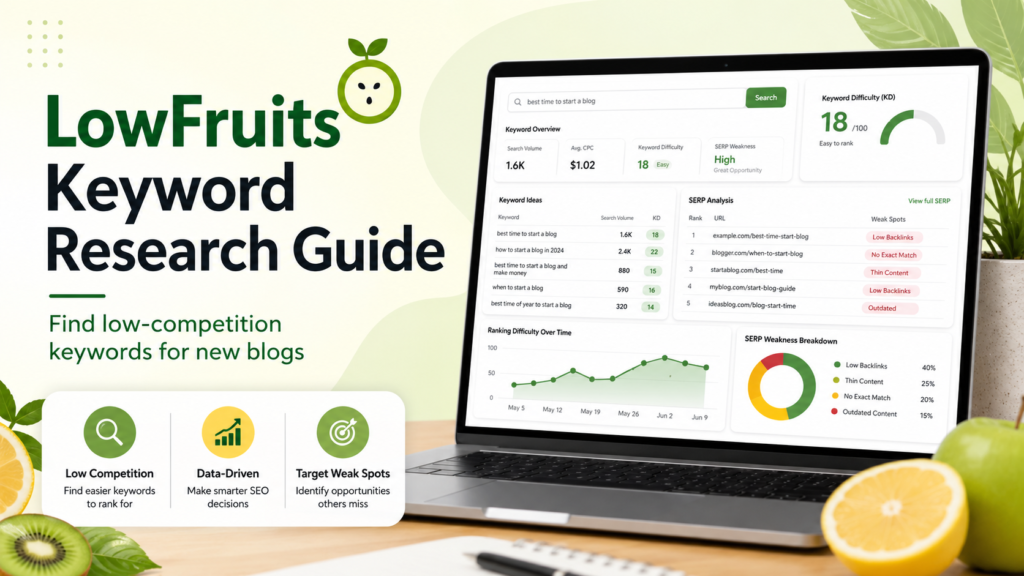
Keyword research is one of the most important parts of an SEO strategy. Before spending hours writing a great article, it makes sense to check whether people are actually searching for the topic and whether your site has a realistic chance to rank.
This is especially important for a new blog. Big SEO tools can be very useful, but their keyword difficulty metrics often place a lot of weight on backlinks. Backlinks matter, of course, but a young website usually cannot compete on link authority with large publishers.
That is where LowFruits takes a different approach. Instead of focusing only on a generic difficulty score, it analyzes the search results and looks for weak spots: pages already ranking that may be easier to beat with a focused, useful article.
Key Takeaways
- Long-tail keywords give newer blogs a more realistic path to organic rankings.
- LowFruits analyzes live SERPs for weak spots such as forums, social pages, and low-authority blogs.
- Prioritize relevance, intent, and weak results over search volume alone.
- Credit packs can suit occasional keyword research, while subscriptions fit ongoing SEO work.
Table of Contents
- Why Long-Tail Keywords Matter for New Blogs
- What Makes LowFruits Different
- Start With One Seed Keyword
- Choose Between All Ideas and High-Intent Ideas
- Use the Questions Tab for Informational Articles
- Analyze Only the Keywords You Want to Target
- How to Read the LowFruits Keyword Results
- Check the Competition Before Writing
- A Practical Way to Find Low-Hanging-Fruit Keywords
- Credits, Packages, and Subscription Options
- Final Thoughts: Focus on Opportunities You Can Actually Win
Why Long-Tail Keywords Matter for New Blogs
A long-tail keyword is a more specific search phrase. It normally has lower search volume than a broad keyword, but it can also have clearer intent and less competition.
For example, “travel to Italy” is broad and highly competitive. A phrase such as “is December a good time to travel to Italy” is far more specific. It may not show a huge volume estimate, but it is exactly the kind of question a helpful travel article can answer properly.
Low volume does not mean zero traffic. No keyword tool can give perfectly exact traffic numbers. A page that answers a specific question well can rank for the main phrase and for many related variations, so these small opportunities can add up over time.
For informational content, question-based keywords are particularly useful. They reveal exactly what people want to know, making it easier to create an article with a clear answer and strong structure. Google also recommends creating helpful, people-first content, as outlined in its guidance on helpful content.
What Makes LowFruits Different
The main idea behind LowFruits is simple: find keywords where the top results contain pages that are not impossible to compete with.
A weak spot in the search engine results pages, or SERPs, can be:
- A forum thread, even when it appears on a high-authority domain.
- A social platform result, such as Quora or Reddit.
- A page from a low-domain-authority blog.
- A result that does not fully satisfy the search intent.
This is much more practical than looking only at a number. If the first page includes forum discussions or low-authority blogs, that is a signal that Google may still be looking for a better, more complete answer.
The best opportunities usually have multiple weak results in the top 10, especially if one or more appears in the top three positions. This does not guarantee a ranking, but it gives a newer site a much more realistic target.
Start With One Seed Keyword
The workflow starts with a seed keyword. This is the broad topic from which you want to discover more specific phrases.
In the example, the seed keyword is “travel to Italy”. Inside the keyword finder, you can set several options before searching:
- Maximum domain authority: A filter for the authority of competing results. For a new site with domain authority below 20, it is often better to leave this blank rather than filter too aggressively.
- Country and Google database: Choose the location that matches your target market. The example uses Google.com for the United States, but other countries are available.
- Negative keywords: Exclude words that are not relevant to your site or planned article.
Once the settings are ready, run the keyword search. The tool can return a very large list of keyword ideas from a single seed phrase.
Choose Between All Ideas and High-Intent Ideas
After the initial search, LowFruits presents options for accessing the keyword ideas. One option is to retrieve the full list. Another is to focus on high-intent phrases, including terms such as:
- best
- review
- comparison
- versus
- how to
- why
This is useful when the purpose is commercial or transactional content. For example, “best” and “review” can point toward affiliate-style articles, while “how to” and “why” often point toward informational content.
The useful part is that keyword discovery and SERP analysis are separate steps. You can first look through the ideas, then choose only the keywords worth analyzing. This prevents spending credits on every phrase in a long list.
Use the Questions Tab for Informational Articles
After collecting ideas, the list is divided into suggestions and questions. The questions section is excellent when you want to write informational articles, guides, and FAQs.
For a travel topic, examples might include questions about travel requirements, timing, weather, or practical planning. These phrases often make excellent article titles or H2 sections inside a larger guide.
You can narrow the question list by question modifiers such as:
- are
- can
- do
- does
- how
- is
- which
- why
Use these filters to find a content angle that matches your expertise. A specific question with a modest volume estimate can still be a very good article if the SERP is weak and the topic is useful for your audience.
Analyze Only the Keywords You Want to Target
After selecting promising ideas, you can add them to a list, export them for further review, or analyze them directly inside LowFruits.
The analysis is the important moment because it checks the SERPs in real time. Credits are consumed when you choose to analyze the selected keywords, not while you are simply browsing the ideas.
This gives you a sensible workflow:
- Generate a large group of long-tail keyword ideas.
- Filter the list by intent, question type, or relevance.
- Select a small group of promising phrases.
- Analyze their SERPs.
- Prioritize keywords with real weak spots.
|
How to Read the LowFruits Keyword Results
Once a keyword is analyzed, the results page adds useful filters and SERP details. You can filter for analyzed keywords, monthly search volume, People Also Ask data, and keywords with weak results.
PAA means People Also Ask. It indicates whether a keyword is connected with questions appearing in that Google SERP. This can give more ideas for sections to cover in your content.
The most useful filters are:
- LowFruits: Shows keywords with at least one weak spot in the top 10 results.
- Top 3: Shows keywords with at least one weak spot among the top three positions.
- Volume: Lets you focus on a monthly search-volume range.
Do not use volume as the only decision factor. A keyword with volume around 30 but no weak competition may be harder than a smaller keyword with several weak pages ranking in the first page.
The results also show SERP features such as featured snippets, image results, and People Also Ask boxes. These elements can affect the shape of the results page and how much space organic listings receive. A SERP with fewer features can sometimes be easier to enter, although the quality and relevance of your content remain essential.
Understand Blue and Green Weak Spots
LowFruits highlights different kinds of weak spots. Blue entries can include forum or social results such as TripAdvisor, Quora, or Reddit. Even when those sites have strong overall authority, a focused article can often provide a more complete and better-organized answer than a discussion thread.
Green entries generally identify regular websites or blogs with low domain authority. If a low-authority page is ranking, that is a useful indication that a well-written article from another smaller site may also have a chance.
For every selected keyword, you can open the SERP details, inspect the results, check the query on Google, and copy information for your research. This manual review is important. A tool can identify opportunities, but you should always look at the actual ranking pages before deciding what to write.
Check the Competition Before Writing
The competition analyzer provides a broader look at the sites ranking for the keywords you selected. It can show the domain, domain authority, and the type of website competing in those SERPs.
You may find a mix of:
- Large media sites
- Affiliate sites
- Government websites
- Social platforms
- Blogs
- Ecommerce stores
This is valuable because ranking is not only about the keyword. It is also about understanding the kind of content Google is rewarding and the types of sites already present.
If the results are mostly government sites or highly authoritative publishers with perfect content, the keyword may not be the right first target for a small site. If the results are mixed with forums, social pages, and small blogs, it is much more interesting.
A Practical Way to Find Low-Hanging-Fruit Keywords
A good keyword is not simply the one with the highest volume. For a newer blog, a practical target combines relevance, clear intent, and visible weaknesses in the SERP.
Use this simple checklist before committing to an article:
- Is the keyword closely related to your site and audience?
- Does the phrase reveal a clear informational, commercial, or transactional intent?
- Are there weak spots in the top 10 results?
- Are any weak spots in the top three?
- Can you create a more useful, specific, and complete page than the current results?
- Does the ranking page type match what you plan to publish?
The most exciting opportunities have three, four, or five weak positions in the SERP, plus enough search demand to make the topic worthwhile. But even a low-volume phrase can be worth targeting if it is highly relevant and easy to answer better than the existing pages.
Credits, Packages, and Subscription Options
Another difference with LowFruits is its credit-based model. You can choose a subscription if you do keyword research every month, or you can buy credit packs when you need them.
The useful thing about credit packs is that, in the example shown, the credits do not expire. This is a calmer solution for bloggers who do not need a big SEO tool every single month. You can buy credits, use them when planning content, and return when you need more research.
The exact prices, credit quantities, discounts, and plan features can change over time, so always check the current offer before purchasing. The demonstration showed packages and subscriptions as two different approaches:
- Credit packs: Best when keyword research is occasional and you want to pay only when you use the tool.
- Subscriptions: Better for larger websites, agencies, or anyone doing regular keyword research at scale.
Subscription plans may also include additional features, such as extracting keywords targeted by weak competitors and SERP or ranking tracking. These features are more useful when keyword research is a recurring part of your SEO work.
You can also add your own domain to the platform to track its domain authority. This helps you see where your site stands as it grows, although domain authority should be treated as a comparative metric rather than the final measure of SEO success.
Final Thoughts: Focus on Opportunities You Can Actually Win
For bloggers, affiliate marketers, and small site owners, the difficult part of keyword research is not finding more keywords. It is finding the right ones.
LowFruits is built around that practical problem. Start with a seed keyword, collect long-tail ideas, filter for questions or intent, analyze only the strongest candidates, and look for weak spots in the SERP.
Instead of trying to compete immediately for the broadest and hardest keywords, build your site with specific articles that solve real search queries. Those are the small opportunities that can bring early rankings, useful traffic, and a stronger foundation for your blog.
You can start with free credits and decide whether the workflow fits your way of doing keyword research. If you choose to purchase credits through the LowFruits bonus link, it includes the promotion described with the original recommendation.
Frequently Asked Questions
What is LowFruits used for?
LowFruits is used for keyword research and SERP analysis. It generates long-tail keyword ideas and identifies weak spots among the pages ranking in Google.
What is a weak spot in LowFruits?
A weak spot is a ranking result that may be easier to outperform, such as a forum post, a social result, or a page from a low-domain-authority website.
Are low-volume keywords worth targeting?
Yes. Low-volume long-tail keywords can still bring traffic and may rank for related phrases. They are particularly useful when the search results show weak competition and the topic is relevant to your site.
Should a new website use the maximum domain authority filter?
For a very new site with low domain authority, leaving the filter blank can be more useful. It allows you to evaluate the actual SERP weaknesses instead of excluding opportunities too early.
|
Last Updated on August 28, 2026 by Logan Carter
